
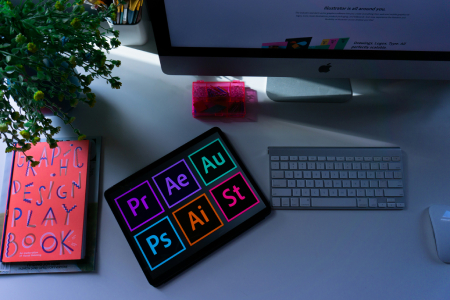
With approximately 61.43% market share, Adobe is “the” monopoly in the creative design software market place.
The monopoly translates into big profits. In the first quarter of 2025, Adobe has achieved revenue of $5.71 billion. Based on this figure, its estimated revenue for 2025 will be $23 billion.
How does Adobe’s dominance affect the average small business?
“It’s bizarre how the whole creative industry relies on just one company.” Reddit commenter.
Adobe’s dominance in the creative industry market has both positive and negative effects.
Without a doubt, Adobe is innovative. The company started an evolution in how content is published, starting with its invention of Postscript, which changed how documents are printed. With its initial desktop publishing program, PageMaker, it changed how documents were designed and published. The Portable Document Format, also known as pdf, revolutionized the market place by making document sharing consistent across different devices.
With products such as Photoshop (photo editing), Illustrator (vector images), Premiere (video editing), and InDesign (desktop publishing), Adobe has become the industry standard across multiple industries.
Adobe’s products are so renowned, that even the word “photoshop” has transcended its product line to become a verb in everyday language.
The negative aspects of Adobe’s market dominance
Adobe serves a global, diverse market. That diversity means that the features in its product lines need to cover every aspect of the industry.
For solopreneurs in creative fields, working with Adobe is a must due its widespread use. For solopreneurs who do not need day to day graphic design, Adobe might not meet your needs for the following reasons.
1. Huge learning curve
All of Adobe’s flagship programs require additional training, effort and time to learn the techniques required to get results. That complexity is one of the reasons why software such as Canva was able to gain ground with non-design savvy users. However, Adobe has countered with intuitive and easy options, such as Firefly and Express, designed to be used with little cost and minimal training.
2. Expensive with a perpetual subscription
Adobe’s billion dollar success is mainly due to its shift in 2013 from a product based business to a software as a service (SaaS) model. With its recurring income model, customers must pay a monthly fee for long as they need Adobe’s products.
A perpetual subscription is inconvenient for those who only need to use design tools occasionally. And even among those businesses who need Adobe, forums such as Reddit are full of complaints about the cost of the subscription model, even 10 years later.
3. Lack of transparency
Adobe has raised concerns about its lack of transparency and has also eroded trust among some users.
Several high profile adverse incidents demonstrate that Adobe’s customers are on high alert and are guarding themselves against the company’s future actions.
The company is currently facing investigation from the Federal Trade Commission of the United States government for hiding information about cancellation fees. Customers who tried to cancel their monthly plan — after discovering they had unknowingly committed to a one-year contract — were often hit with steep early termination fees.
While Adobe has stated that issues can be resolved through customer support, the process is time-consuming and frequently leaves users frustrated.
Adobe has recently had to defend itself against accusations of using customers work to train its AI. That such a statement had to be made in the first place demonstrates customers’ growing lack of trust in the company, and the perception that the company does not have its customers’ best needs at its forefront.
4. Resource heavy
Adobe’s programs are resource heavy. For instance, users of programs such as Premiere have to upgrade their hardware or increase memory, increasing their overall business expenses. Many users report frequent slowdowns, crashes, and unresponsive performance, which further adds to their frustration.
Are there any credible alternatives to Adobe?
There are no easy alternatives to Adobe’s products. The superiority of their products makes it difficult for other platforms to compete on the same scale.
While Adobe’s issues have made it vulnerable to competition, no other company has been able to provide the span of features or integration that Adobe has.
Ironically, Canva which was created in 2013 as a way to simplify graphic design, may soon face the same problems as Adobe. The company is considering an initial public offering, which will result in higher prices due to stockholder expectations. In a way, it has already started to mimic Adobe, with its recent purchase of Affinity products, as well as Leonardo.ai, an AI art creation tool.
Affinity products (Affinity Designer, Affinity Photo and Affinity Publisher) could all be considered as alternatives to the Adobe Creative suite. The products are one time purchase, which a huge advantage over Adobe. All three products can be bundled in a single purchase. However, since Canva acquired Affinity in 2024, it remains to be seen if Affinity can maintain its independent status in terms of pricing and setting itself apart from Adobe and Canva.
Other alternatives in the graphic/creative market place include:
Photoshop: Affinity Photo, GIMP (free), Canva (free), Photopea (free), Pixlr (free + paid)
Illustrator: Corel Draw, Affinity Designer, Inkscape (free)
Premiere: Da Vinci (free + paid), CapCut (free + paid)
InDesign: Quark Xpress, Canva, Affinity Publisher.
Most of these alternatives offer the advantage of low monthly fees or one-time payments, along with a simpler learning curve. They are generally designed to provide simple solutions for everyday users.
However, for more advanced or complex creative needs, Adobe often remains the only viable option — largely due to its dominant position in the market.
Photo by Emily Bernal | Unsplash